
When you start looking at grinding equipment, one of your first questions is probably, “Will this machine work for the parts we make?”
It’s a good place to start. You know your parts, your customers’ expectations, and the challenges your team faces each day. Maybe you spend too much time finishing a surface, struggle to get consistent results, or wait on an outside grinding service.
At DCM Tech, our Technical Specialist start by learning about your application. These seven questions can help you prepare for that conversation and explore whether rotary surface grinding is a good fit for your parts.
1. What material is my part made from?
Tell us specifics about your material, including its grade, heat treatment, or coating. Even when two parts look similar, those details can affect how they grind.
DCM Tech rotary surface grinders support applications involving ferrous and nonferrous metals, glass, ceramics, carbide, and composites. Each application needs an appropriate combination of abrasives, work holding, and process settings.
If you’re unsure where your material fits, that’s something we can explore together.
2. What are my part’s dimensions and shape?
A drawing or a few photos give us a helpful starting point. Share the part’s length, width or diameter, thickness, weight, desired flatness and surface finish with tolerances, and along with the surface you need to grind.
We’ll consider how the part fits on the machine, the space needed for a fixture, and access to the grinding surface.
If your shop handles a variety of parts, show us that range. Understanding your smallest and largest components helps us look at your needs beyond a single job to size your machine appropriately.
3. How will the grinder hold my part?
You want to feel confident that your part will stay secure and supported throughout the grinding cycle. Fixturing deserves attention early in the conversation.
Magnetic fixtures can suit appropriate ferrous materials. Surface grinding for nonmagnetic materials, such as glass, ceramics, or aluminum, may require a vacuum fixture or a mechanical fixture.
DCM Tech offers different solutions depending on the application. We’ll help you evaluate an approach that suits your part’s material and shape.
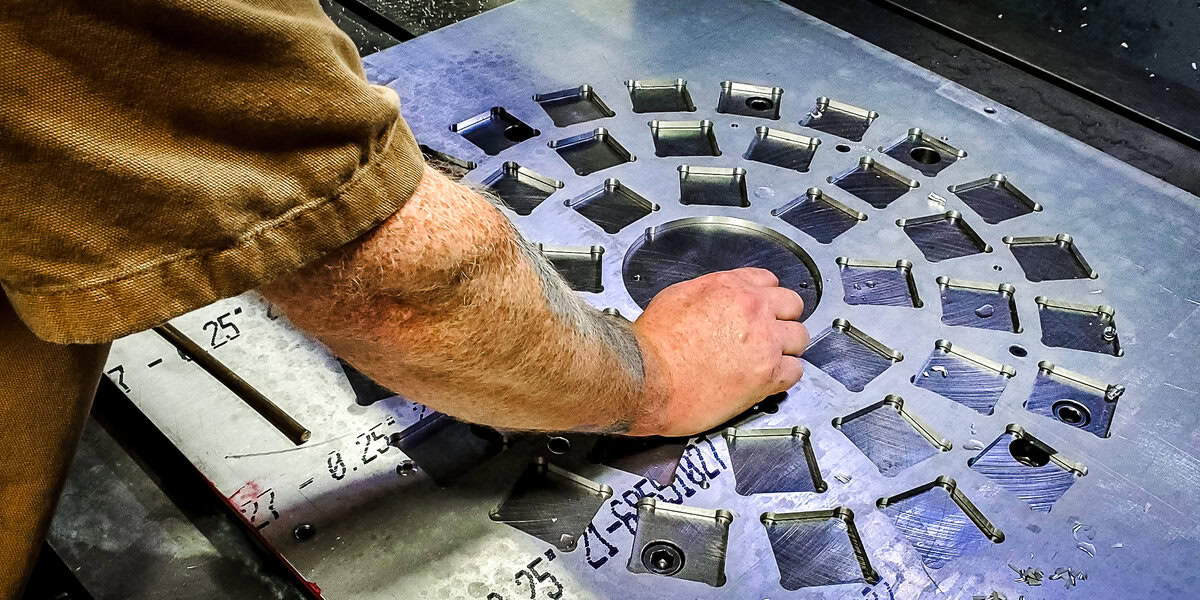
A custom fixture developed by the DCM engineering team.
4. How much material do I need to remove?
Are you removing a substantial amount of stock, making a light finishing pass, or restoring a worn surface?
Share your starting and target dimensions, including how much the incoming parts vary. Those details help us understand what the grinding process needs to accomplish.
It also helps to know what happens afterward. If another operation removes additional material, we can include that step when evaluating the overall process.
5. What tolerances and surface finish do I need?
Your finished-part requirements give us a clear goal. Bring specifications for thickness, flatness, parallelism, and surface finish whenever you have them.
If you’re still defining those requirements, tell us what your customer expects and where your current process falls short.
For precision surface grinding to tight tolerances, a trial with a full load of representative parts helps establish what a particular material and setup can achieve. It gives you results to review against your own acceptance criteria.
6. How many parts do we need to process?
Think about a typical week in your shop. How large are your batches? How often do operators change jobs? Do you run the same part regularly or handle a changing mix of work? Do you plan to integrate automation?
We’ll look at setup, loading, grinding, unloading, and inspection when discussing processing time.
Tell us where you expect production to go, too. Understanding your current volume and future plans helps us evaluate a grinding process that suits your operation.
7. What would I most like to improve?
This may be the most useful question of all.
Perhaps your team spends hours finishing work. Maybe inconsistent thickness creates rework, or outsourcing makes it difficult to meet delivery dates. Whatever prompted your search, we want to understand it.
Record a few measurements from your current process, such as processing time, rejected parts, outside grinding costs, or time spent on rework. These give you a practical way to evaluate whether bringing surface grinding in-house or upgrading an existing grinder would help.
Let’s take a closer look at your part
You don’t need to have every answer before reaching out. A part, a drawing, and a conversation about what you’d like to improve are enough to get started.
Through DCM Tech’s free sample grind, your regional technical specialist will discuss your requirements and coordinate testing of your parts at our factory in Winona, Minnesota. You’ll receive a grind report, images, video, and a testing summary to help you evaluate the results.
Have a part in mind? We’d welcome the chance to learn about it and help you explore your options.